
Is this guide for you?
- You spend most of the night on your left or right side
- You wake up with a stiff neck, sore shoulder, or tingling arm
- Your current pillow flattens within an hour of lying down
- You're a broader-shouldered sleeper struggling to find enough loft
Jump to a section
Quick verdict
If you want the shortest route to the right choice, start here.
- Prioritise your shoulder width and overall frame (drives loft).
- Prioritise whether you sleep hot, cold, or neutral.
- Prioritise any neck or shoulder pain you wake up with.
Best options at a glance
These options cover the most common buying paths for side sleepers: strongest baseline fit, value route, and a balanced upgrade path.
#1 · Best overall fit for this profile
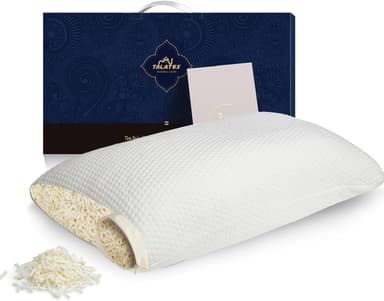
Talatex Talatex Adjusted Cervical Pillow
Best for side sleepers who want structured support.
Included for allergy-aware materials and easier maintenance.
Approx. £59.99/item
#2 · Best value alternative

Silentnight Silentnight Adjustable Memory Foam Pillow
Best for combination sleepers who want structured support.
Included for better heat control and overnight comfort consistency.
Approx. £44.99/item
#3 · Best upgrade alternative
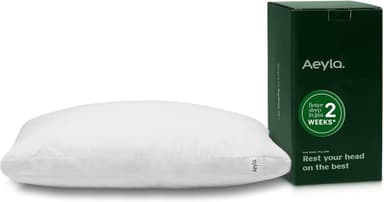
Aeyla Aeyla Dual Pillow Adjustable 2-in-1
Best for combination sleepers who want structured support.
Included for better heat control and overnight comfort consistency.
Approx. £58.74/item
How we ranked these options
We rank these options by fit for side sleepers, combining support profile, temperature behavior, and value for money. The goal is to improve sleep comfort and consistency first, then refine feel preferences.
- Your shoulder width and overall frame (drives loft)
- Whether you sleep hot, cold, or neutral
- Any neck or shoulder pain you wake up with
Quick Buy
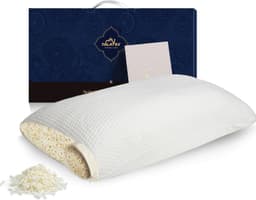
Talatex Talatex Adjusted Cervical Pillow
Built for adjustable side-sleeper support and better loft control.
We use Talatex here because side sleepers usually need the most control over loft and support.
Approx. £59.99/item
Read full guide for this topic →Buy Talatex nowWant the full pillow overview?
If you want to compare the whole landscape before reading a specific guide, start with our central best pillow page.
Read: Best Pillow guide →How the matching quiz works
- Answer a few quick questions about how you sleep
- We match against pillows verified on UK Amazon, scoring on fit, temperature and budget
- Get a shortlist with reasons — not a single pushed product
Why side sleepers need a different pillow
When you lie on your side, the gap between your ear and the mattress is roughly the width of your shoulder — typically 10–15 cm for adults. A pillow has to fill that gap so your cervical spine stays in a straight line from skull to mid-back. Drop too low and the head tilts down, stretching the muscles on the upper side of the neck. Sit too high and the head tips up, crunching the lower side. Either way, you wake stiff. Back sleepers, by comparison, only need to fill 5–8 cm — which is why a generic supermarket pillow often feels fine on your back but wrecks you on your side.
The three things that actually matter
Forget marketing claims about thread count and 'cloud-like comfort'. For a side sleeper, three measurable properties decide whether a pillow works:
1. Loft (height when lying on it)
Aim for a compressed loft of 10–14 cm. Smaller-framed sleepers (under ~165 cm tall, narrower shoulders) sit at the lower end; broader sleepers need closer to 14 cm. Adjustable-fill pillows let you remove or add filling until it matches.
2. Firmness and support
Side sleepers need medium-firm to firm support that holds its shape all night. Soft down or polyester clusters compress under the weight of the head and re-create the same alignment problem you started with. Memory foam, latex and shredded-foam fills tend to keep their loft for years.
3. Temperature
Side sleepers trap more heat against the pillow than back sleepers because more of your face and neck is in contact with the surface. If you run warm, look for open-cell foam, latex with pinholes, or a cover with phase-change fabric — and avoid solid memory foam without ventilation.
Materials compared for side sleeping
Memory foam holds its loft well and contours around the head, which suits most side sleepers — but solid blocks can sleep hot. Shredded memory foam keeps the contour benefit and lets air move through. Latex feels springier and naturally cooler, with a longer lifespan, though it costs more. Down and feather are luxurious but compress quickly under side-sleeping pressure unless they're high-fill-power and densely packed. Microfibre and polyester fills are the most affordable but lose loft fastest — fine as a stop-gap, less good as a long-term match.
Common mistakes side sleepers make
Stacking two soft pillows
Two thin pillows together create an unstable stack that shifts during the night. One correctly-lofted pillow is always better than two wrong ones.
Buying for how it feels in the shop
A pillow you press with your hand for three seconds tells you almost nothing. What matters is how it behaves under 4–5 kg of head weight for eight hours. Always check the brand's returns policy.
Ignoring the pillowcase
A tightly-woven cotton or bamboo case lets a breathable pillow breathe. A polyester satin case can undo the cooling benefits of a £90 latex pillow.
Ready to skip the research?
Answer a few quick questions and we'll match you to pillows that fit your build, position and budget.
Start the 2-minute quizWhat our quiz looks at
- Your shoulder width and overall frame (drives loft)
- Whether you sleep hot, cold, or neutral
- Any neck or shoulder pain you wake up with
- Your fill preference: foam, latex, down, or microfibre
- Your budget — strong UK options exist from £25 to £120
- Whether you need machine-washable or hypoallergenic
Frequently asked questions
How firm should a pillow be for side sleepers?
Medium-firm to firm. Soft pillows compress too far under the weight of your head and let your neck drop out of alignment. If you currently use a soft pillow and wake with neck stiffness, firmness is the first thing to change.
What loft (height) is right for side sleepers?
Most adult side sleepers do best with a compressed loft of 10–14 cm. Narrower-shouldered sleepers sit at the lower end; broader-shouldered sleepers need the upper end. An adjustable pillow lets you fine-tune by adding or removing fill.
Is memory foam or latex better for side sleeping?
Both work well. Memory foam contours more closely and absorbs movement, which suits sleepers who want a 'sinking' feel. Latex is springier, naturally cooler, and longer-lasting, which suits sleepers who run warm or dislike a moulded feel.
Can a pillow fix neck pain?
A correctly-matched pillow can stop a pillow from causing neck pain — which is often where the pain is coming from. It is not a medical treatment. If pain persists for more than a couple of weeks after switching to a properly-lofted pillow, see a GP or physiotherapist.
How often should I replace my pillow?
Most pillows lose meaningful support after 18–24 months. Latex and high-density memory foam can last 3–5 years. If you fold yours in half and it stays folded, it's done.
Last reviewed: 30 April 2026. We update this guide when our verified pillow catalogue changes.
Generated with GitHub Copilot.